
The 7 A's and the 6 F's
What Every Man Needs Before He'll Let You Lead Him
Last week we mapped out the descent and the ascent of a man's interior life — the Six D's that kill a dream and the Seven L's that bring it back. That post was about what happens inside one man; this one is about what happens between two.
There's a reason men don't stay in discipleship programs, and it's not the reason most of us assume. It isn't that they don't want to grow, and it isn't that they don't believe in accountability. It's that somewhere between the first conversation and the third session something quietly breaks, and from that point forward they start ghosting, drifting, making excuses, and finding ways to stop showing up — usually without ever telling you why.
I watched it happen for years and assumed the problem was them, until I picked up a book that reframed everything I thought I understood about how men actually open up to being led.
Where This Started
The Warrior Soul: Five Powerful Principles to Make You a Stronger Man of God by Lieutenant General Jerry Boykin and Dr. Stu Weber — two Army Green Berets who spent their lives forging warriors in both the military and the church — introduced me to four A's of relational trust that form the bookends of the progression: Acceptance at the front door, Affirmation as the relationship begins to mature, and Accountability and Authority as the fruit that comes out the other side when the groundwork is done right.1

Their argument was straightforward: before you can lead a man anywhere, he has to experience certain relational realities with you. Not concepts. Not ideas he agrees with theologically. Lived experiences in the relationship itself. Without them, the man will nod at your teaching, shake your hand at the door, and never come back with anything real.
That framework stuck with me, but over the years of actually walking it out with men, I noticed there were gaps in the interior of the progression that Boykin and Weber hadn't named directly. Acceptance was the front door, but how does a man get from Acceptance to Affirmation? And once he has been accepted and affirmed, what builds the bridge from there to Accountability and Authority? I kept encountering men who had clearly been accepted and affirmed by their pastors and mentors but still wouldn't let anyone past the surface, and the failure was never in the bookends — it was in the middle, where the relational connective tissue was missing.
So I added three more A's of my own to fill those interior gaps: Admiration between Acceptance and Affirmation (because you cannot genuinely affirm a man you do not actually respect), Approachability between Affirmation and Affection (because being told you are seen is not the same thing as believing you can come to your mentor when you fall), and Affection as the relational warmth that has to exist before Accountability can land as brotherhood rather than surveillance. The bookends came from Boykin and Weber; the middle came from watching men drop out of relationships that technically had all the "right" pieces but had never been stitched together into something a man could actually live inside.
The 6 F's — the pattern of what happens when the A's aren't there — came from a place I didn't expect. They came from my own family.
A Personal Confession
When my father died, my brother David and I went through a season that nearly destroyed our relationship, and it happened in a way I didn't see coming until we were already deep in the middle of it. We argued about what Dad would have wanted — the arrangements, the decisions, the legacy questions that always seem to surface when a patriarch passes and the sons are suddenly left holding pieces they don't know how to assemble on their own. It was ugly in the quiet way these things usually are, not the kind of ugly that makes for a dramatic story, but the kind that happens in short text messages and long silences and phone calls where nobody says what they actually mean.
I lived through every one of the F's during that season: the fight response, the frustration of going around in circles, the fatigue of sustained relational tension, the facade of pretending things were fine whenever we were together at family gatherings, the forgetfulness of anything good that had ever existed between us, and the slow-growing sense that separation — emotional if not physical — was the only viable option I had left.
It was only much later, after God did the slow, unglamorous work of reconciliation between us, that I realized something obvious: my father wouldn't have wanted us arguing about what he would have wanted. The irony of that hit me hard. And it made me look at the F pattern with new eyes — not as a theory, but as something I had walked through personally and watched dozens of men walk through in my years of ministry.
A Brother Worth Mentioning
Before I walk through the A's, I want to give a shout-out to my friend Jordan Northrup. Jordan is a Marine Corps Lieutenant Colonel with twenty years of service and three combat tours to Iraq and Afghanistan. He wrote The War Inside: Finding Victory Over Alcohol — a brutally honest account of his fourteen-year battle with addiction and how God brought him from utter hopelessness to a place of grace, healing, and restored identity.2

Jordan didn't contribute directly to the 7 A's and 6 F's framework, but his work on identity, warfare, and recovery has deeply influenced how I think about what men need in order to let another man lead them. If you're walking with men who are battling addiction or who have lost their sense of who they are in Christ, Jordan's book and his ministry at jordannorthrup.com are resources I'd put in their hands without hesitation.
He embodies what Boykin and Weber describe in The Warrior Soul — a man who fought, fell, surrendered to God, and came back stronger. That's the kind of warrior-friend every man needs in his corner.
The 7 A's: What a Man Must Experience Before He'll Let You In

Four U.S. Marines from a tank crew standing together in front of their M1A1 Abrams — "Heavy Metal Brotherhood." Different backgrounds and different stories, but the same uniform and the same mission, which is exactly what authentic relationships look like when they have been built right from the ground up. (Public domain, U.S. Marine Corps photo)
These aren't nice-to-haves; they are prerequisites for real discipleship — doors that must be walked through in sequence, and if you try to skip one you'll find yourself building the whole relationship on sand. The bookends of this progression — Acceptance, Affirmation, Accountability, and Authority — come from Boykin and Weber, and the three that fill the interior — Admiration, Approachability, and Affection — I added through years of trial, error, and the kind of failures that only teach you something if you're honest enough to look at them in the mirror afterward.
Before a man can change, he has to believe he is welcome as he is — not his best self, and not his cleaned-up Sunday version, but the actual man who yells at his kids, who hasn't opened his Bible in three weeks, and who carries shame he hasn't told another soul about. If he senses that your love is conditional or contingent on his performance and progress, he will never let you past the surface, no matter how many weeks he keeps showing up.
This is what Jesus modeled more consistently than almost anything else in His earthly ministry. He didn't wait for people to get it together before He sat with them. The tax collectors (Matthew 9:10–13), the woman at the well (John 4:7–26), the man at the pool of Bethesda who had been waiting thirty-eight years for someone to help him into the water (John 5:1–9) — He accepted them first. Transformation came after, and it came because the acceptance was already established.
Paul understood this when he wrote to the church in Rome:
"Therefore, accept one another, just as Christ also accepted us, to the glory of God." — Romans 15:7
The standard for our acceptance of other men is Christ's acceptance of us — which means it precedes performance, not rewards it.
Men need to be genuinely respected rather than flattered or managed with strategic compliments, and every man I have ever walked with can smell the difference from a mile away. Fake admiration repels him the moment it reaches him, but real admiration — the kind that comes from actually seeing his strength, his effort, and the heart behind his fumbling attempts to lead his family — unlocks something in him that nothing else can touch.
This is why great leaders in any domain — military, athletic, pastoral — know their people's strengths before they ever address their weaknesses. You cannot lead a man you secretly look down on, and he will know. Maybe not consciously, but he'll feel it in the way you talk to him, and he'll withdraw. I added Admiration as an A of its own because I kept watching leaders skip from Acceptance straight to Affirmation without ever actually looking closely enough to respect the man they were trying to affirm — and men can feel that shortcut from a mile away. Find something real to admire in the man in front of you; if you can't find it yet, you haven't looked hard enough.
The writer of Hebrews gives us the model:
"And let us consider one another in order to stir up love and good works." — Hebrews 10:24
The word "consider" there — katanoeo in Greek — means to observe carefully, to study, to give sustained attention.3 You can't admire a man you haven't studied. And you can't stir him up toward love and good works if he doesn't believe you've actually seen him.
When we admire someone we are simply taking note of what we see, but when we affirm him, we actually have to speak. Affirmation is what we say out loud, and men are starving for it — not because they are weak, but because most of them grew up in environments where, whether intentionally or unintentionally, it was always withheld. Fathers who showed love through provision but never through words, coaches who used silence as a motivational tool, and a broader culture that has long treated male vulnerability as something to be mocked rather than honored have all conspired to leave a generation of men starved for the one thing they can't generate for themselves: the sound of another man speaking truth about who they are out loud.
Specific, earned affirmation changes men in a way that generic encouragement never will. "You're doing great, bro" is noise, but "I watched you choose your family over that opportunity last week — that was a hard call, you made the right one, and that's the kind of man I want my sons to become" is a different category of statement altogether. Say something like that out loud, mean it when you say it, and watch what happens in his eyes when he realizes you actually saw him make that choice.
The Apostle Paul practiced this relentlessly. Read the opening of nearly any of his epistles and you'll find specific, detailed affirmation of the people he was about to challenge. He didn't start Romans with a list of problems. He started with:
"I thank my God through Jesus Christ for all of you, because your faith is being reported all over the world." — Romans 1:8
He built the relational floor before he walked on it.
This is the pivot point in the framework. A man can feel accepted, admired, and affirmed — and still hide from you if he believes that failure will cost him the relationship. Approachability answers the question every man is silently asking: Can I come to you when I fall, or does falling mean I lose what we have?
Approachability isn't about being soft — it's about being safe, which is a very different thing. A man won't bring you his real problems — the pornography struggle, the financial disaster, the marriage that's dying behind a smiling Facebook profile — if he's already rehearsing your disappointment in his head before he opens his mouth. The most dangerous thing that can happen in a discipleship relationship is when a man starts performing for his mentor instead of being honest with him, because at that point you're no longer discipling a man at all; you're discipling a facade he built to protect himself from you.
James understood this:
"Therefore confess your sins to each other and pray for each other so that you may be healed." — James 5:16
Confession requires approachability. If the relational environment punishes honesty, a man will simply stop being honest. And then you'll wonder why he left — when the truth is he left long before his body stopped showing up.
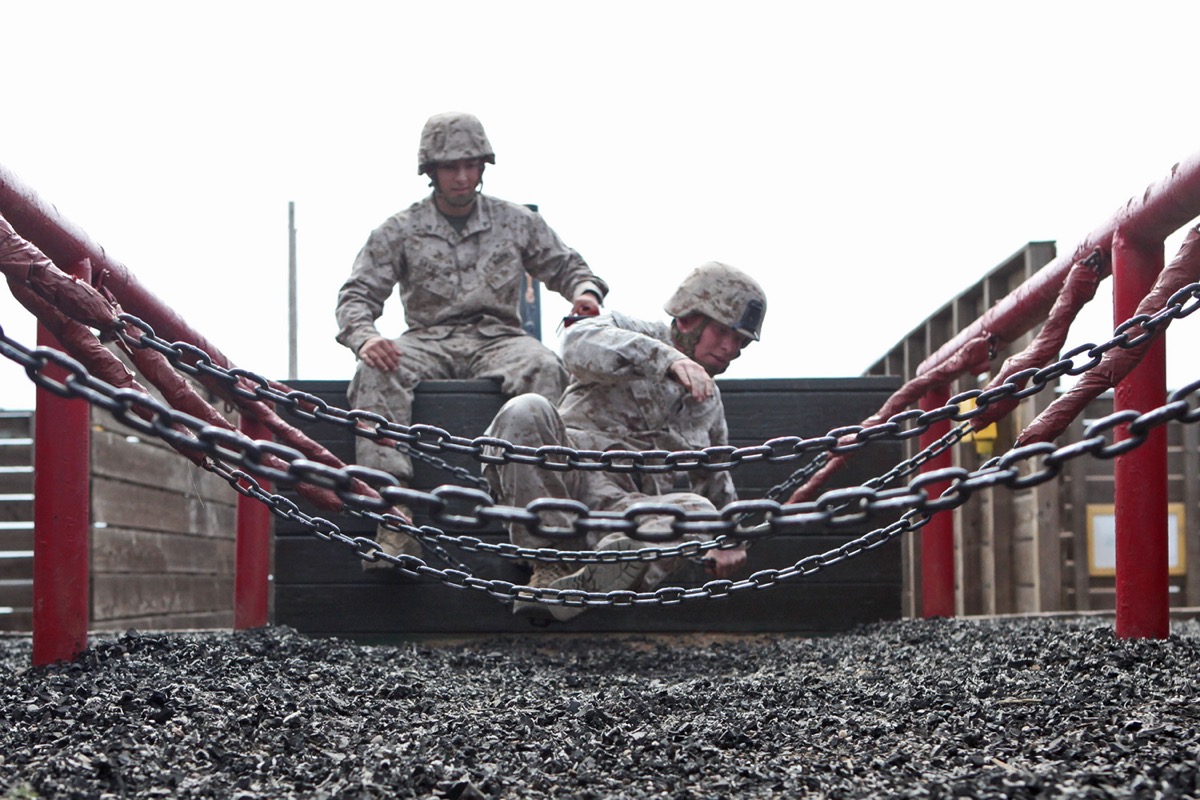
A Marine from Combat Logistics Battalion 5 stands ready to help another Marine crossing a chain bridge on the leadership reaction course at Camp Pendleton. Not reaching yet, but ready to reach — which is exactly the posture the 7 A's are meant to build in a man. (Public domain, U.S. Marine Corps photo)
This is the A that makes men the most uncomfortable, but it's also the one whose absence I've watched kill more discipleship relationships than theological disagreement ever has.
Men need to know that the relationship is more than transactional — that you actually care about him as a person, not just his attendance at your Bible study or what he can contribute to the ministry. Affection in discipleship looks like remembering the small things he mentioned in passing three weeks ago, checking in when there's nothing to check in about, and showing up when he's struggling with no agenda other than your own presence beside him. It's love with skin on it, and the hard truth is that most men have never experienced it from another man outside of a combat environment.
Paul described this to the Thessalonians with a vulnerability that still surprises me every time I read it:
"We were well-pleased to impart to you not only the gospel of God but also our own lives, because you had become very dear to us." — 1 Thessalonians 2:8
Paul didn't just give those men information. He gave them himself. And the word he uses for "very dear" — agapetos — is the same word the Father uses of the Son at His baptism. That's the depth of affection Paul brought to discipleship. If a former Pharisee and Roman citizen could be that tender with a group of men, the rest of us have no excuse.
Now we're in harder territory, and here is where the sequence matters most: this is the sixth A, not the first, and the order is not accidental. Once a man has experienced acceptance, admiration, affirmation, approachability, and genuine affection — once he knows deep down that you are for him rather than just monitoring him — the whole dynamic changes, and he doesn't just tolerate being held accountable; he actually starts to ask for it. He calls you at midnight because he needs someone to say "don't do it," and he trusts that you'll say it with love rather than condemnation.
Demanding accountability without the first five A's in place is just surveillance, and men hate being surveilled, so they'll comply on the surface and route around you underneath every single time. I've watched it happen in military formations, in church small groups, and in marriage counseling sessions where the man gives you the answers he thinks you want while the real struggles stay buried under the floor. But when accountability lands inside a relationship where the first five A's have been firmly established, something different happens entirely: two men make each other sharper precisely because neither one is afraid of the friction anymore.
"As iron sharpens iron, so one man sharpens another." — Proverbs 27:17
Notice that the proverb doesn't say "as a hammer beats iron into shape" — it says iron sharpens iron, which means the relationship is mutual, and the posture is side by side rather than top down. True accountability means calling a man what he is — a son of God, a husband, a father, a man of purpose — rather than just cataloging what he has done wrong, and because he already trusts you by this point, the sharpening cuts clean instead of wounding.
Paul ties accountability and love together so tightly you can't separate them:
"Instead, speaking the truth in love, we will grow to become in every respect the mature body of him who is the head, that is, Christ." — Ephesians 4:15
This is the whole game, and it's the whole game precisely because authority in a discipleship relationship cannot be seized — it can only be given, and it is given entirely on the man's own terms.
Authority in discipleship is not conferred by a title, a credential, or an ordination certificate hanging on your office wall; it is the sum total of the A's a man has experienced with you, and nothing more. The degree to which he has been accepted, admired, affirmed, found you approachable, felt genuine affection, and been held accountable in love — that is the measure of your authority. He grants you the right to speak into his life because he has tested the relationship across six dimensions and found it trustworthy, which is why this final door cannot be kicked open from the outside; you can only earn the key by building the first six A's, one by one, over time.
This is why Jesus taught with an authority that astonished people who were accustomed to the scribes and Pharisees:
"And they were astonished at his teaching, for he taught them as one who had authority, and not as the scribes." — Mark 1:22
Jesus didn't appeal to other rabbis' opinions or cite His credentials when He taught; He spoke from relationship, from truth, and from demonstrated love — and people gave Him authority willingly because they were experiencing something with Him that they had never once experienced from the religious establishment that surrounded them.
A man who grants you authority over his life is the most coachable, transformable human being on earth — not because he is complying out of obligation, but because he is submitting out of trust, and trust fully established across all seven A's means that nothing is off the table between the two of you. You can ask him the hardest question you can think of, you can challenge his deepest assumptions, and you can call him into the kind of uncomfortable growth that would have sent him running six months earlier, because by this point he knows you're leading from love rather than leverage. Get to number seven, and that's when the real work begins.

Three CH-46 Sea Knights hovering in formation, still wearing the old-school green — the now-retired aircraft known to its crews as the "Battle Phrog," "God's Chariot," and a few other names that are considerably less flattering. I flew the Phrog until 2013 before transitioning to the MV-22, and the one thing every pilot knows — regardless of which airframe you end up in — is that formation flight only works when trust has already been built on the ground long before the rotors start turning. (Public domain, U.S. Marine Corps / DPLA photo)
The 6 F's: What Happens When the A's Aren't There
I didn't develop the 6 F's in a classroom or from a book. I developed them in the wreckage of my own family after my father passed.
When Dad died, my brother David and I entered a season of conflict that followed this pattern with almost clinical precision. We argued about what our father would have wanted — the kind of decisions that surface when a patriarch passes and the sons are left to interpret a legacy they assumed would always be there to speak for itself. Looking back, I can trace each F like waypoints on a map.
It took time, grace, and the work of the Holy Spirit to bring us through it. And the realization that arrived on the other side was painfully simple: Dad wouldn't have wanted us arguing about what he would have wanted. He would have wanted us walking together. The very thing we were fighting to honor, we were dishonoring by the way we fought.
That experience taught me more about what happens when relational trust breaks down than any book could have. Here's the pattern I've seen since — in families, in churches, in discipleship relationships, and in military units where the leadership failed to build the A's before demanding performance.
The prefrontal cortex shuts down when something in the relationship registers as a threat — judgment, comparison, exposure, or the quiet sense that vulnerability will eventually be used against him — and once that happens, the man in front of you isn't thinking clearly anymore, he's reacting. He does one of three things at that point: he fights (deflecting, arguing, going on the offensive), he flees (missing sessions, ghosting, finding reasons to be unavailable), or he freezes (showing up physically but shutting down completely and giving you nothing real to work with).
This isn't rebellion; it's biology. Dr. Bessel van der Kolk's work in The Body Keeps the Score demonstrates that relational trauma activates the same neural pathways as physical danger,4 which means that when a man feels unsafe in your discipleship relationship his body responds before his theology has a chance to intervene. The sympathetic nervous system doesn't distinguish between a physical threat and a relational one — and if you don't understand that, you will consistently mistake a wounded nervous system for a rebellious heart.
Don't take it personally; diagnose it instead. The threat isn't you specifically — it's the absence of one or more of the A's — and the work in front of you is to figure out which one is missing and rebuild it before you push for any more growth.
At this stage the relationship starts to feel like work with no return, because the man came expecting growth and got guilt instead, or he came looking for brotherhood and got homework. Frustration is the gap between expectation and experience, and it reliably signals that one or more of the A's is either weak or missing from the relationship. The frustration itself is information — it is not a problem to be managed out of existence, but a diagnostic indicator to be read carefully by anyone paying attention.
There is only so long a man can stay in a relationship that costs him more than it gives him before something in him finally gives out, and when it does, he stops showing up with any real energy. He is tired of performing, tired of the distance between who he actually is and who the relationship seems to demand he become overnight, and tired of carrying a weight he never agreed to pick up in the first place. This is the stage that kills slowly — not with a dramatic exit, but with a gradual reduction in energy, initiative, and presence until the man who used to text you first now only responds when you reach out, which is the quiet signature of a relationship already in its dying hours.
Larry Crabb described this in Connecting: relationships either restore the soul or drain it, and there is no neutral middle ground.5 A discipleship relationship that drains a man — that adds weight without adding life — is a relationship in failure mode, even if all the right words are being said.
A fatigued man stops trying to actually grow and starts trying to look like he's growing, because the appearance of growth is far less costly than the real thing. He knows what to say in the group, he knows how to answer the accountability questions, and the relationship continues in form even though nothing real is happening underneath the surface. You're discipling a performance — and the genuinely terrifying part is that both of you can go months (sometimes years) without either one naming it out loud.
Patrick Morley calls this "the imposter" — the man who shows up at church for thirty years and never lets a single person actually see him.6 The 6 F's are the autopsy; but the 7 A's are the antidote!
There comes a point in every failing relationship where a man can no longer access the good that used to exist in it, because the accumulated weight of the recent pain has buried every earlier memory that should have anchored him. He can't remember why he started, he can't recall the moments of genuine connection that once held the relationship together, and all that remains in his conscious mind is the pile of expectations he couldn't meet alongside the authenticity he couldn't risk.
This is the stage I found myself in with David, where the good years of brotherhood had been completely overwritten by the recent conflict and I genuinely couldn't access the memories that should have anchored the two of us. That wasn't a character flaw on my part or his, and it isn't one in any other man who ends up here either — it's simply what unresolved relational pain does to the human heart given enough time and enough silence.
Eventually the relationship ends — either by his choice, by the structure collapsing around both of you, or by a mutual fade that neither person is willing to name out loud. He sets "healthy boundaries" that may or may not actually be healthy, or he simply stops showing up without explanation, and he leaves more guarded than when he arrived. The real tragedy is that the next man who tries to disciple him will face a higher wall than you ever did, because failed discipleship relationships don't just end; they leave scar tissue that the next person has to work through before any trust can be rebuilt.
This is the outcome you're trying to prevent, and the only way to prevent it is to build the A's before you try to build anything else.
The Framework at a Glance
Buy-In Before Build-Up
The first three to four sessions of any discipleship or coaching relationship aren't about content. They're about building the A's. Before you hand a man a reading plan, a growth chart, or a list of habits, take honest inventory:
- Does he feel accepted as he is right now — not as the version of himself you're hoping to produce?
- Has he seen genuine admiration from you, not flattery?
- Have you affirmed something specific and real?
- Does he believe he can come to you at his worst without rehearsing your reaction?
- Has he experienced affection — the kind that shows up with no agenda?
Run intake not as data collection but as A-building. Every question is an invitation to trust. Every interaction in those early weeks is either opening a door or closing one. Only when you've walked through all seven does real discipleship begin. And then the 6 F's lose their power — because a man who is fully known and fully loved has nothing to hide and nothing to fear.
The Authority Question
Someone once asked me, "What is your authority?" — and it remains one of the best questions anyone in men's ministry has ever put to me, because the honest answer is not what most people assume it would be.
The honest answer isn't my credentials, my time in service or the rank I held, my M.Div. from Liberty, my endorsement from the Christian Leaders Alliance, or even the number of years I've been doing ministry and the number of men I've walked with along the way. My authority with any given man is the sum of the A's he has experienced with me — nothing more and nothing less. The degree to which he has been accepted, admired, affirmed, found me approachable, felt genuine affection, and been held accountable in love is the exact measure of what I can ask of him, and no certificate hanging on an office wall can make up for missing any one of those ingredients.
And the day I try to exercise authority I haven't earned through relationship is the day I become a Pharisee — loading men with burdens I'm not willing to carry alongside them:
"Woe to you lawyers also! For you load people with burdens hard to bear, and you yourselves do not touch the burdens with one of your fingers." — Luke 11:46
Jesus had authority because He loved people better than anyone had ever loved them in their entire lives, and they gave Him everything in return — not because He demanded it of them, but because they experienced something real with Him that they had never experienced anywhere else. Go and do likewise.
Your Next Step
Pick one man in your life this week and ask yourself honestly which of the 7 A's is weak in your relationship with him — and then resist the temptation to respond by adding another session or piling on more content, because those are the moves that got you here in the first place. Just add one A, intentionally and without fanfare, and watch what happens over the next few weeks.
And if you're sitting on the other side of the table — if you're the man being discipled and one of the F's in this post looks a little too familiar — you don't have to ghost the relationship to escape it. You can speak the truth out loud, name which of the A's is missing, and ask for what you actually need, because the iron-sharpens-iron principle cuts in both directions, and the man leading you cannot fix a gap he doesn't know exists.
"A new commandment I give to you, that you love one another: just as I have loved you, you also are to love one another. By this all people will know that you are my disciples, if you have love for one another." — John 13:34–35
Notes
- Jerry Boykin and Stu Weber, The Warrior Soul: Five Powerful Principles to Make You a Stronger Man of God (Lake Mary, FL: Charisma House, 2014). Boykin was a founding member of Delta Force and later served as U.S. Deputy Undersecretary of Defense for Intelligence; Weber is a Green Beret veteran and pastor. Four of the A's in this article come directly from their framework — Acceptance (stage 1), Affirmation (stage 3), Accountability (stage 6), and Authority (stage 7) — forming the bookends of the progression. The three interior A's — Admiration (stage 2), Approachability (stage 4), and Affection (stage 5) — along with all six F's, are my own additions, developed through years of men's ministry as I noticed gaps in the connective tissue between Boykin and Weber's original four. ↑
- Jordan Northrup, The War Inside: Finding Victory Over Alcohol (2019). Available through jordannorthrup.com. Jordan is a Marine Corps Lieutenant Colonel with twenty years of service and three combat tours to Iraq and Afghanistan. Jordan did not contribute to the 7 A's and 6 F's framework, but his work on identity, warfare, and recovery has shaped how I think about what men need in order to let another man lead them. ↑
- Katanoeo (κατανοέω) — BDAG glosses this as "to think about carefully, consider, contemplate" and "to notice, observe carefully." The prefix kata- intensifies the verb noeo ("to perceive, think"), signaling sustained, attentive observation. The word appears 14 times in the New Testament and is used by Jesus in Luke 12:24 ("consider the ravens") and Luke 12:27 ("consider the lilies") — always with the sense of "look long enough to actually see." ↑
- Bessel van der Kolk, The Body Keeps the Score: Brain, Mind, and Body in the Healing of Trauma (New York: Penguin, 2014). Van der Kolk's research as director of the Trauma Center in Boston established that the autonomic nervous system responds to perceived threats — including social and relational threats — with the same fight, flight, or freeze cascades it uses for physical danger. For pastoral and ministry application, see also Curt Thompson, Anatomy of the Soul (Tyndale, 2010). ↑
- Larry Crabb, Connecting: Healing Ourselves and Our Relationships (Nashville: Word Publishing, 1997). Crabb's central thesis — that the deepest healing happens not in counseling rooms but in ordinary relationships where the soul is touched — reframes "discipleship" from a curriculum into a quality of connection. ↑
- Patrick Morley, The Man in the Mirror: Solving the 24 Problems Men Face (Grand Rapids: Zondervan, 1989; revised edition 2014). Morley's "the imposter" concept describes the man who has been pretending so long he can no longer locate his own honest self. The book has been a foundational text in evangelical men's ministry for over three decades and was my first exposure to the idea that men need a different kind of discipleship than the standard small-group Bible study provides. ↑
Scripture References
All verses link to the U.S.M.C. Ministries Bible Translation Engine for full context, cross-references, and the MOOP translation.
- Matthew 9:10–13 — Eating with sinners
- John 4:7–26 — The woman at the well
- John 5:1–9 — The man at the pool
- Romans 15:7 — Accept one another
- Hebrews 10:24 — Consider one another
- Romans 1:8 — Faith reported
- James 5:16 — Confess and heal
- 1 Thessalonians 2:8 — Our own lives
- Proverbs 27:17 — Iron sharpens iron
- Ephesians 4:15 — Truth in love
- Mark 1:22 — Authority unlike scribes
- Luke 11:46 — Burdens hard to bear
- John 13:34–35 — Love one another
Sources & Recommended Reading
Jerry Boykin & Stu Weber — The Warrior Soul: Five Powerful Principles to Make You a Stronger Man of God (Charisma House, 2014) · source of four A's: Acceptance, Affirmation, Accountability, and Authority
Jordan Northrup — The War Inside: Finding Victory Over Alcohol (2019) · jordannorthrup.com
Bessel van der Kolk — The Body Keeps the Score: Brain, Mind, and Body in the Healing of Trauma (Penguin, 2014) · ISBN 978-0143127741
Larry Crabb — Connecting: Healing Ourselves and Our Relationships (Word, 1997) · ISBN 978-0849916441
Patrick Morley — The Man in the Mirror: Solving the 24 Problems Men Face (Zondervan, 1989/2014) · ISBN 978-0310331759
Curt Thompson — Anatomy of the Soul: Surprising Connections Between Neuroscience and Spiritual Practices (Tyndale, 2010) · ISBN 978-1414334158
This post mapped the outside game — what happens between two men. The companion piece maps the inside game: the Six D's that kill a dream and the Seven L's that bring it back.
Read The DL →Ready to build the kind of brotherhood the 7 A's describe? Start the Watchman Bible Reading Plan — 5 watches a day, built for men who lead.
Start the Watchman Plan →Adam "MOOP" Johns is a Christ-following husband and father, retired Marine Corps aviator and combat veteran (21 years of service), NASM-certified personal trainer, and men's discipleship coach who has been investing in the formation of men for over 25 years. He holds an M.Div. from Liberty University and founded U.S.M.C. Ministries — Uniting, Serving, Mentoring & Counseling — in Fredericksburg, VA.